
AI for Business: A Plain-Language Guide for Malaysian SME Owners
No jargon, no sales pitch. Just a simple explanation of what AI can do for Malaysian SMEs — what can be automated intelligently, what it costs, and how to think about it.

"AI-Powered Business Solutions." Sounds like something only big corporations with 500 employees need, right?
Wrong. If you run a business with even 3 staff members, you're probably doing things manually that a simple system could handle for you — saving you hours every single week.
This guide breaks down AI solution in plain language. No jargon, no MBA talk. Just practical stuff for Malaysian bosses who are too busy running their business to read a 50-page whitepaper.
So What Exactly Is AI solution?
AI-Powered Business Solutions (AI solution) simply means: getting a computer to do the repetitive stuff your team is doing manually.
That's it. No AI robots taking over. No million-ringgit SAP system. Just smart tools that handle the boring, repetitive work so your people can focus on things that actually need a human brain.
Simple Examples of AI solution
See? Nothing scary. It's just making the computer do what your team is already doing — but faster, more accurately, and without forgetting.
Why Malaysian SME Bosses Should Care

Let's be honest. Running an SME in Malaysia is already hard enough:
- Margins are tight — everything from rent to raw materials keeps going up
- Staff turnover is high — you train someone for 3 months, they leave for RM200 more elsewhere
- Competition is everywhere — your competitor down the road just started using GrabFood and you're still taking orders by phone
- You're the boss, the manager, the HR, and sometimes the delivery driver
With all that going on, the last thing you need is your admin spending 2 hours every day copy-pasting data from WhatsApp into Excel.
Automation doesn't replace your staff. It frees them up to do work that actually matters — like serving customers better, following up on leads, or managing quality.
What Can You Actually Automate?
Here's a practical breakdown. Honestly rate yourself — how many of these are you still doing manually?
Sales & Orders
- Auto-generate quotations from templates
- Order confirmation → invoice → receipt flow
- Payment reminders via WhatsApp
- Commission calculation for sales staff
Inventory & Stock
- Real-time stock tracking across outlets
- Auto-reorder when stock is low
- Expiry date tracking (food, beauty products)
- Supplier price comparison
HR & Staff
- Attendance tracking (clock-in via phone)
- Leave request & approval flow
- Payroll calculation with OT, EPF, SOCSO
- Staff performance dashboard
Operations & Admin
- Customer follow-up reminders
- Service scheduling & job assignment
- Daily/weekly/monthly reports auto-generated
- Document filing & retrieval
If you're doing 3 or more of these manually, automation could save your business 10-20 hours per week. That's practically hiring an extra staff member — without the salary.
How Much Does It Cost? (The Honest Answer)
This is the question every boss asks first. Let me be straightforward:
AI solution Investment Range for Malaysian SMEs
The question isn't really "can I afford automation?" It's: "can I afford NOT to automate?"
Think about it: if your admin spends 3 hours a day on manual data entry, that's roughly RM1,500–2,000/month in wages just for copy-pasting. Over a year, that's RM18K–24K. A one-time RM8K system that eliminates that work pays for itself in 4-5 months.
The Before & After: A Real Scenario
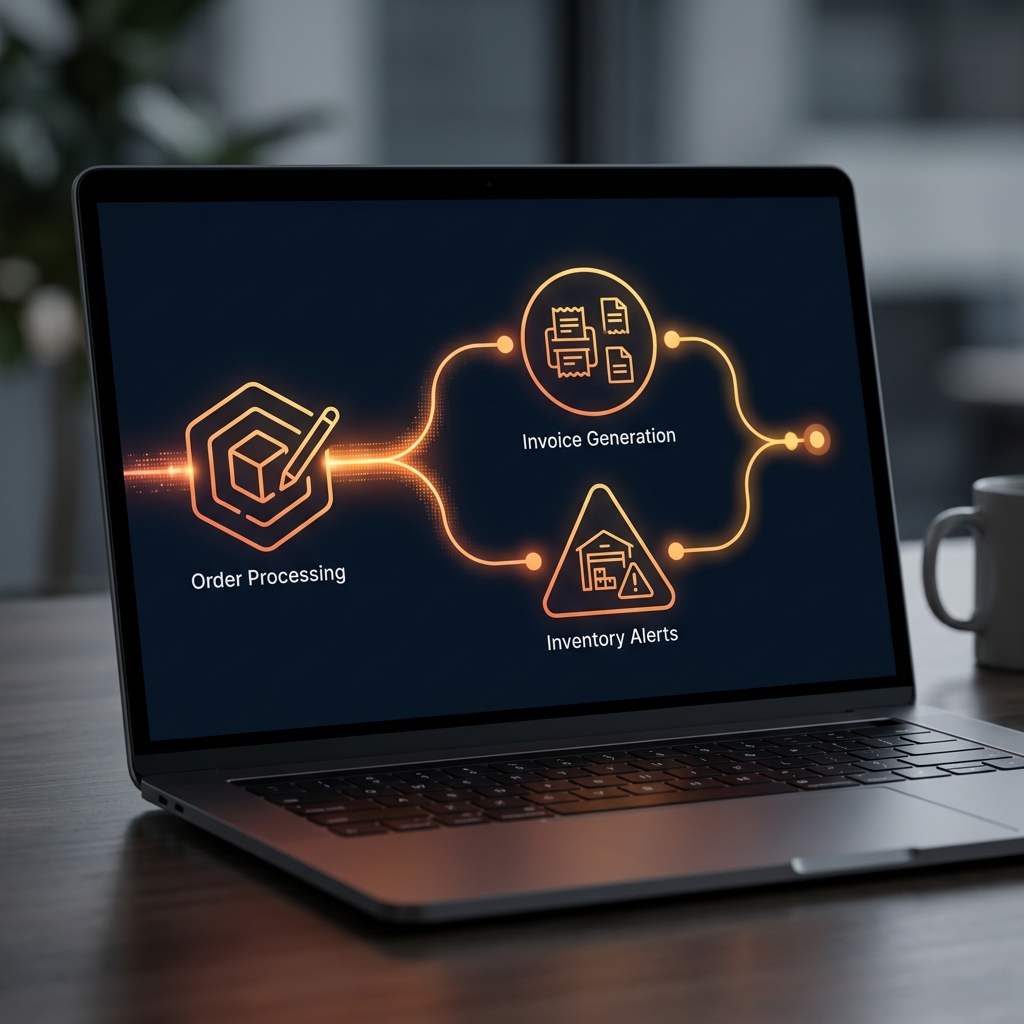
Let's say you run a trading company with 12 staff. Here's what a typical day looks like before and after automation:
- • Customer WhatsApp order → admin types into Excel
- • Admin manually creates invoice in Word
- • Boss checks stock by calling warehouse
- • Accounts person keys in payment data at month end
- • Boss asks "how was business this week?" → nobody can answer instantly
- • Customer orders via form → system creates order + updates stock
- • Invoice auto-generated and sent via WhatsApp
- • Real-time stock dashboard on boss's phone
- • Payment auto-recorded when customer pays
- • Daily P&L report sent to boss at 11pm automatically
That 70 hours a month? Your team can use it to follow up with customers, improve quality, or just go home on time instead of staying late doing data entry.
5 Signs Your Business Is Ready for Automation
Not every business needs to automate everything right away. But if any of these sound like you, it's probably time to start:
You're doing the same thing more than 3 times a day
Typing the same customer details, creating the same reports, sending the same follow-up messages. If it's repetitive, it should be automated.
Your data lives in 4+ different places
Excel here, WhatsApp there, notebook somewhere else. When you need to find something, you have to check 3 apps and ask 2 people.
New staff take weeks to get up to speed
Because your processes are in people's heads, not in a system. When someone leaves, their knowledge leaves with them.
You've lost money due to human error
Wrong price on an invoice. Double-ordered stock. Forgot to follow up with a customer. These mistakes add up.
You can't answer 'how's business?' in under 10 seconds
If you need to open 3 files and ask your accountant to give a simple answer, your data isn't working for you.
How to Get Started (Without Overthinking It)
The biggest mistake SME owners make? Trying to automate everything at once. Don't do that. Here's a better approach:
Write down everything your team does manually every day. Be specific: "Admin keys 30 invoices into Excel every afternoon" — not just "invoicing."
Choose the task that wastes the most time OR costs the most money. That's your first automation target. Start small, see results fast.
Find a solution — whether it's a simple Google Form, an existing app, or a AI-built system. Test it for 2 weeks. Measure the time saved. Then decide what to automate next.
You don't need to spend RM50K on day one. Many businesses start with a RM3K-5K solution that solves their #1 pain point — and the ROI pays for the next phase.
Common Myths That Hold SMEs Back
"Automation will replace my staff"
Reality: It replaces their boring tasks, not their jobs. Your admin goes from data-entry person to someone who actually manages customer relationships. That's an upgrade, not a replacement.
"My business is too small for this"
Reality: If you have even 1 employee doing repetitive work, you can benefit. A nasi lemak stall with good automation can outperform a restaurant chain with poor processes.
"I'm not tech-savvy enough"
Reality: You don't need to understand the technology. You just need to explain your business process clearly. A good system builder translates your workflow into a digital tool. If you can explain how you do things, you can let AI handle them.
The Bottom Line
AI-Powered Business Solutions isn't about being "techy" or "digital-first." It's about being smart with your time.
Every hour your team spends on repetitive manual work is an hour they're NOT spending on serving customers, closing deals, or improving quality.
The best part? You don't need to automate everything. Start with one process. See the difference. Then expand from there.
The Malaysian SME bosses who figure this out now will be the ones who scale, hire better people, and actually enjoy running their business — instead of drowning in admin work every night.
This article is part of our series on business digitalization for Malaysian SMEs. If you found this useful, share it with a fellow boss who's still stuck doing everything manually. Sometimes all it takes is one "aha" moment.