
AI-Powered vs Off-the-Shelf: What Malaysian SMEs Should Know
A practical comparison between off-the-shelf tools and custom AI-built systems for Malaysian SMEs. Learn when each approach makes sense, and how the right AI solution can save 10+ hours per week.

You're running a business in Malaysia. You have 5, 10, maybe 30 staff. Every day, someone is typing data into Excel. Someone else is sending invoices on WhatsApp. Your stock count doesn't match your sales. And you — the boss — are checking everything manually because "the system" doesn't exist yet.
Sound familiar? You're not alone.
According to SME Corp Malaysia, SMEs make up 98.5% of all businesses in the country and contribute 38.4% to our GDP. Yet most are still running on Excel spreadsheets, WhatsApp groups, and a whole lot of manual effort.
This article is for every Malaysian boss who has ever thought: "There must be a better way."
There is. Let's explore it.
Why Off-the-Shelf Software Often Falls Short

Most SME owners have tried at least one of these:
- Excel spreadsheets — great until you have 20 tabs and nobody knows which version is the latest
- Generic POS systems — handles basic transactions, but can't adapt to your specific workflow
- Subscription SaaS tools — you pay monthly for features you don't use, while the feature you actually need is locked behind a premium tier
- WhatsApp + manual processes — works until someone forgets to forward that one message and a RM5,000 order slips through
The core issue isn't that these tools are bad. It's that they're designed for the average business:
Every business has its own quirks, processes, and ways of doing things. That's what makes it yours. When you force it into a generic system, your team creates workarounds — and those workarounds eventually become the real "system."
The result? Your data ends up scattered across 5 different places. You spend more time managing the tools than managing your business.
What "Going Custom" Really Means

When people hear "custom AI system," they picture a RM500,000 enterprise project with 10 developers. That's not what we're talking about.
For an SME, a custom AI system simply means a digital tool that's:
Shaped Around Your Workflow
Your team opens it, sees what they need to do, and does it. No 200-page manual.
Lean on Features
Only the tools that solve your actual problems. No 50 menu items you'll never click.
Connected
WhatsApp notifications, bank sync, supplier management — everything talks to everything.
Grows With You
Start with the basics. Add more next month. No migration, no starting over.
Think of it like clothing: a generic SaaS is a rental uniform — it kinda fits. A custom AI system is a tailored suit — made for your shape, your style, your purpose.
The Hidden Cost of "Free" Tools
Many SME owners think: "Why invest in a system when I can use free tools?"
Fair question. Let's look at what "free" actually costs:
What Manual Work Really Costs a 15-Staff Business
That's money spent on inefficiency — not on growth, not on marketing, not on hiring better people. Just on doing things the slow way.
The insight here isn't "buy a system." It's: what you're doing right now already has a cost — you're just not seeing it.
What Transformation Actually Looks Like
Here's a realistic before-and-after for a typical 15-staff trading business:
- ✗ 4 hours/day on manual data entry
- ✗ Stock count wrong every month
- ✗ Boss checks every invoice personally
- ✗ Reports compiled manually every Friday
- ✗ 3 staff doing admin full-time
- ✓ Data captured automatically at point of action
- ✓ Real-time inventory, always accurate
- ✓ Routine approvals happen automatically
- ✓ Reports auto-generated every morning
- ✓ Admin staff redeployed to revenue-generating roles
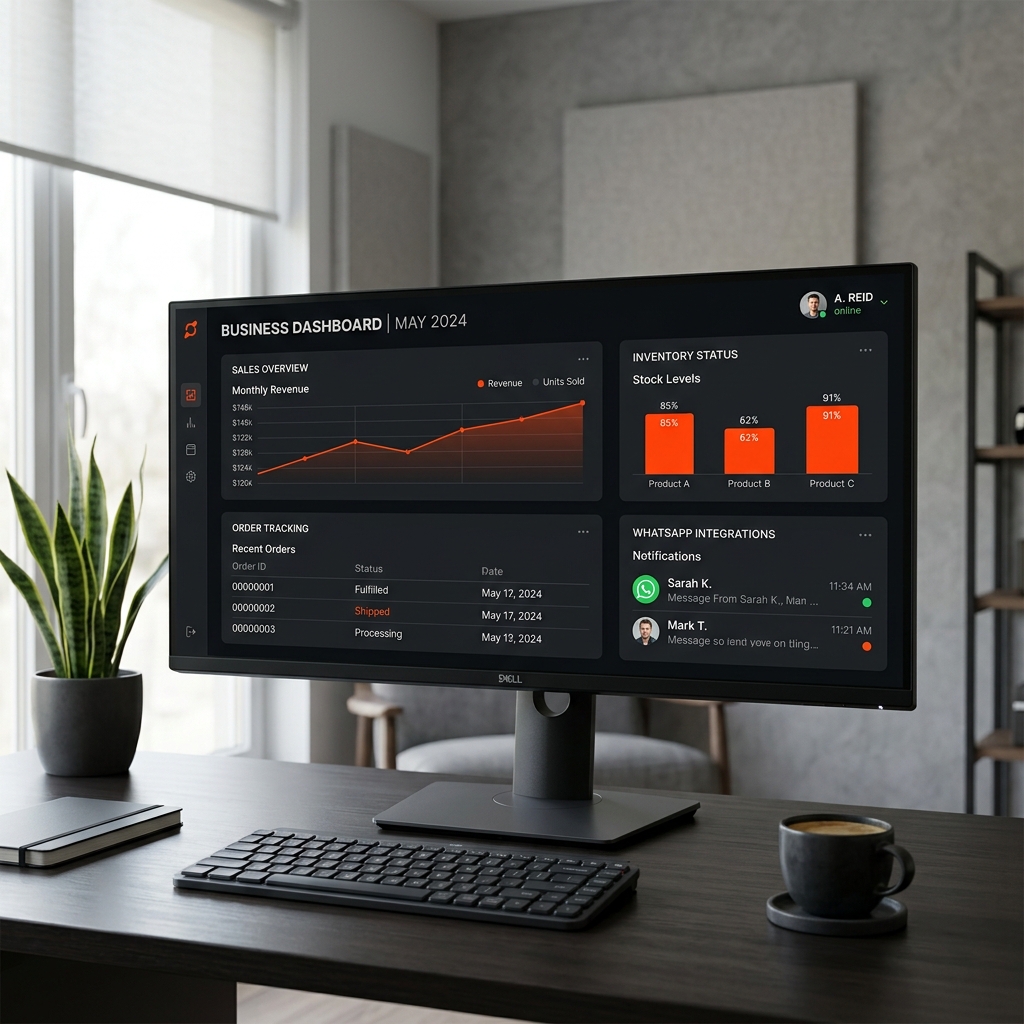
The biggest win isn't just time saved — it's that the boss gets to stop firefighting and start leading.
The "I'm Not Tech-Savvy" Myth
Here's the truth that most tech companies won't tell you:
If you can use WhatsApp, you can use a well-designed system.
The problem was never you. It was the software. Good systems are designed around people — not the other way around. If a system is confusing, that's a design failure, not a user failure.
The key is this: a system should be built by watching how your team actually works first — understanding the daily flow, the pain points, the shortcuts people take. Only then should someone design a solution.
That's why good custom AI systems feel obvious to use. Your staff picks it up in a day, because it mirrors what they were already doing — just without the friction.
Which Industries Benefit Most?
Digital transformation isn't limited to tech companies. Here are the industries where custom AI systems create the most impact in Malaysia:
F&B
Kitchen orders, multi-outlet sync
Retail & Trading
Inventory, supplier tracking
Beauty & Wellness
Appointments, client history
Services
Job scheduling, invoicing
Professional
Project tracking, billing
Construction
Quotations, material mgmt
Education
Enrollment, fee tracking
Healthcare
Patient records, booking
Travel
Itinerary, payment tracking
The common thread? Any business with repetitive manual work, disconnected data, or processes that depend on one person's memory can benefit.
How to Know If You're Ready
You don't need to be a tech expert to start. Ask yourself these three questions:
Does your team use more than 3 unconnected tools?
Excel + WhatsApp + POS + paper = data scattered everywhere. This is the #1 sign.
Does the business stop when you take a day off?
If everything depends on the boss, you don't have a business system — you have a bottleneck.
Do you need 20 minutes to answer "how was business this week?"
A healthy business can answer that question in 5 seconds — from a dashboard, not from asking 3 people.
If any of these resonate, it might be time to start exploring what a custom AI system could look like for your business.
Getting Started: A Practical Framework
If you're considering this path, here's a simple framework that works for most Malaysian SMEs:
Document your current processes. Where does data enter? Where does it go? Where does it get lost?
Don't try to digitalize everything at once. Pick your biggest pain point and solve it first. See results in weeks, not months.
Once the core works, layer on more: analytics, automation, integrations. Your system grows with your confidence.
The most important thing? Start. The gap between businesses that digitalize early and those that wait will only widen. In a market where margins are tight and competition is fierce, the SMEs that embrace systems will outpace those that don't.
The Bottom Line
Malaysian SMEs are the backbone of our economy. They deserve tools that are built for how they actually work — not generic software designed for Silicon Valley startups.
Whether you build it yourself, hire a freelancer, or work with a specialist firm — the important thing is to start treating your business processes as assets worth investing in.
Because the boss who digitalized last year? They're not worried about stock counts anymore. They're not chasing invoices at midnight. They're not checking every WhatsApp message.
They're thinking about what's next.
This article is part of our series on business digitalization for Malaysian SMEs. If you found this helpful, share it with a fellow business owner who could use a different perspective on how technology can serve their business.